
As a mother, you have the right to give the best to your newborn. Breast milk is the best nutrition for your baby. To have the intention to breastfeed is a good start to your baby’s nutrition. Having a nutritious diet will help your body meet the demands of maintaining a healthy pregnancy, and prepare you for lactation and breastfeeding.
Breast milk is the ideal food for your baby as it contains all the nutrition that he needs in the first 6 months of life. The World Health Organization (WHO) recommends exclusive breastfeeding for the first 6 months. Following that, in addition to solid food, you can continue to breastfeed until age 2 years or older.
Mothers may breastfeed their children for two complete years for whoever wishes to complete the nursing (period)”
Surah Al-Baqarah 2:233
- Contains essential vitamins, minerals and nutrients necessary for growth and development.
- Easily digested and less likely to cause stomach upset, constipation or diarrhea.
- Filled with antibodies that boost immunity and reduce risk of infections.
- Reduces the risk of Sudden Infant Death Syndrome (cot deaths) as well as obesity and diabetes in adulthood.
- Allows your womb to contract faster and reduces blood loss after childbirth.
- Delays the return of your menstrual period and is a natural, although imperfect, contraceptive.
- Can burn calories for weight loss.
- Reduces the risk of breast and womb cancer, heart disease and osteoporosis (brittle bones).
- Enhances the special bond between you and your baby.
Benefits of breast milk for baby:
Benefits of breastfeeding for mother:
Preparation should start soon after your delivery:
- Establish your milk supply early by breastfeeding your baby as soon as possible after delivery (ideally within the first hour of birth).
- Breastfeed regularly on demand, 8 to 10 times a day.
- Frequent and effective milk removal is all you need to ensure a constant supply of milk.
- When your baby is not well or separated from you, express breast milk every 3 to 4 hours to keep your milk production going.
- Before you start, always wash your hands thoroughly.
- Ensure all your equipment is clean and sterilised.
- Express your breast milk every 3 to 4 hours and keep it in sterile breast milk zipper bags before storing them in a fridge or freezer.
- Thaw frozen milk in the refrigerator or in a cup of warm water.
- Use the milk immediately and discard the leftover.
- Do not boil or heat breast milk in a microwave.
- Do not re-freeze or re-warm the breast milk.
1. Building a good milk supply
2. Expressing and storing breast milk- using a breast pump or manually with your hand
Storage of breast milk:
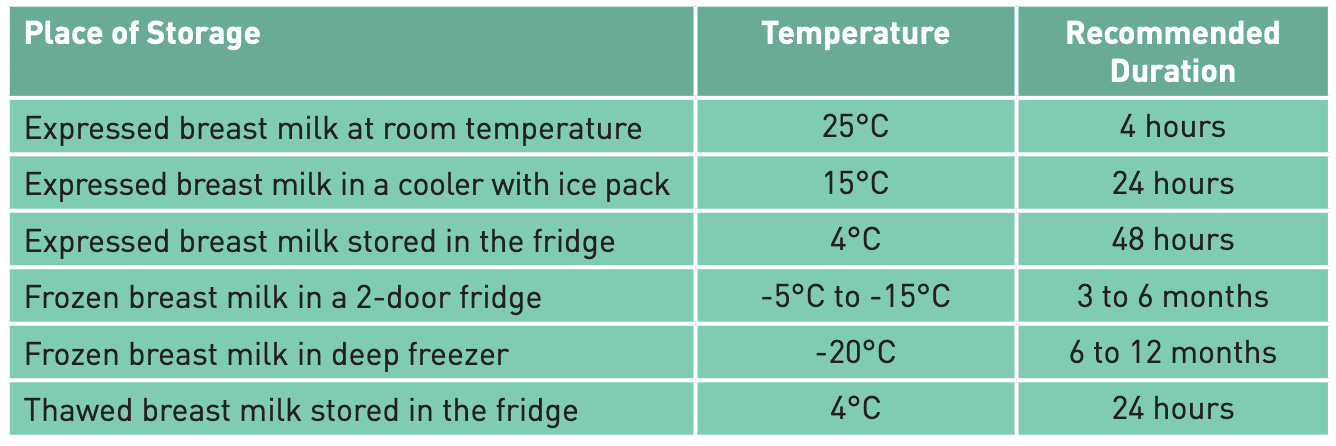
Thawing Process:
3. Nutrition during Breastfeeding
To eat halal and good food and to avoid impurities:
O humanity! Eat from what is lawful and good on the earth and do not follow Satan’s footsteps. He is truly your sworn enemy. [Surah Al-Baqarah 2:168]
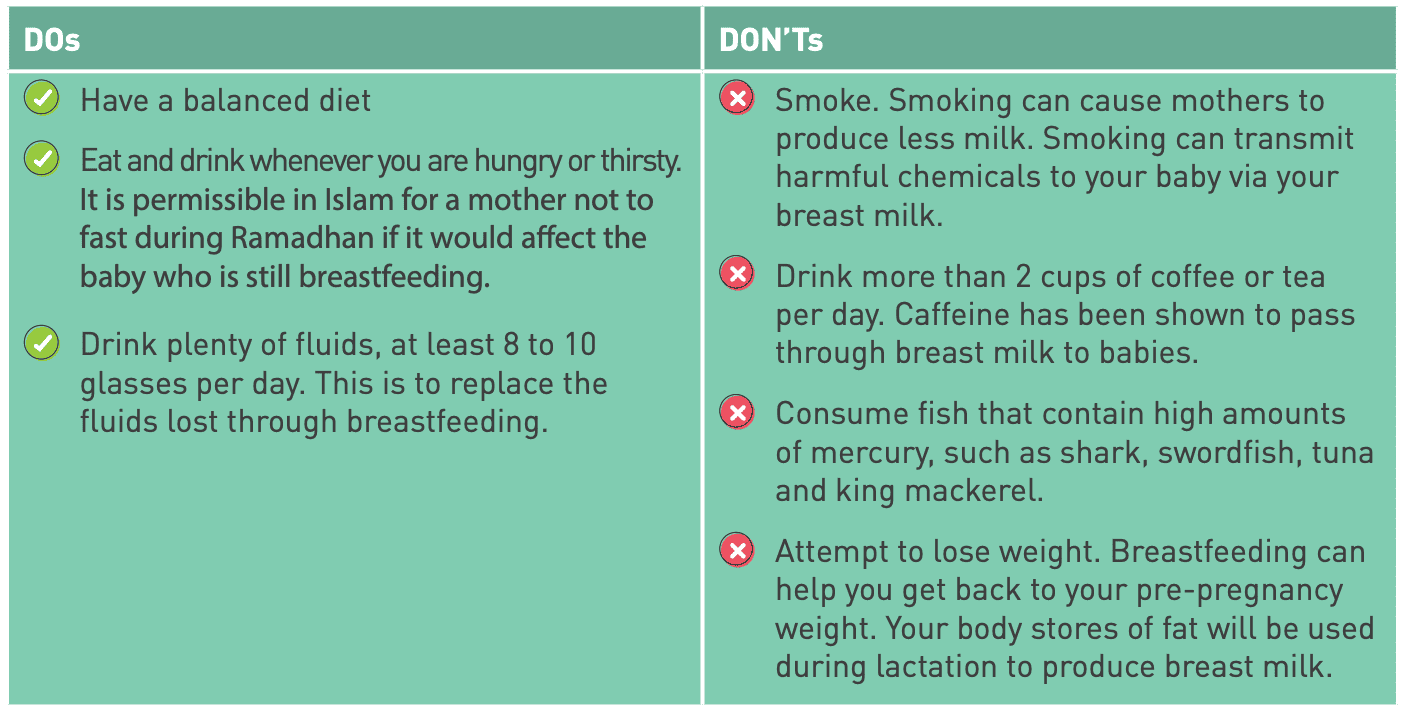
DOs and DON’Ts for a healthy diet when breastfeeding:
- Baby’s chin is touching your breast and his nose is slightly away.
- Baby’s mouth is wide open, covering the areola (dark area around the nipple).
- Baby’s lips form a seal on the breast, with the lower lip turned out.
- You feel the initial tug on your nipple and there is no pain/discomfort.
- Baby is sucking and swallowing with no clicking sounds heard.
Traditional confinement food
Confinement is a period of time after delivery to help the mother recuperate from childbirth. It is part of our culture, and some practices may not be evidence-based. It is however, acceptable to follow traditional practices in moderation as long as it consists of a well-balanced diet. If in doubt, consult your doctor or nurse.
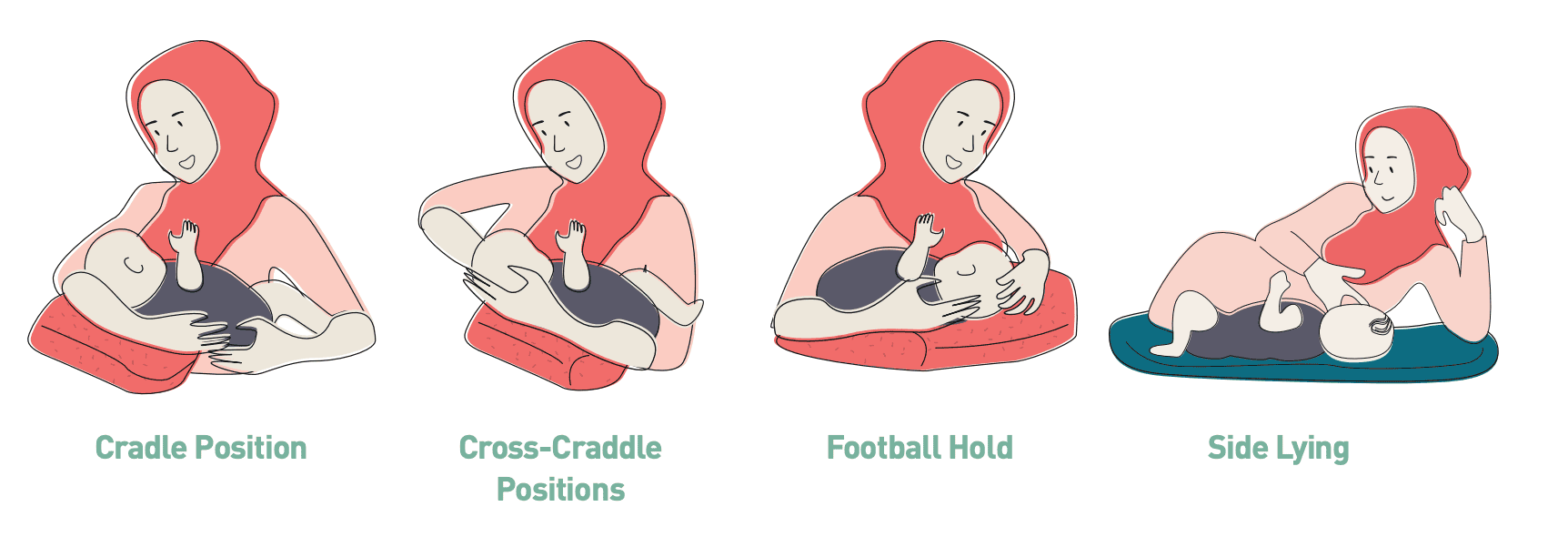
Breastfeeding positions
Finding a comfortable position that works for you and your baby is well worth the effort. A relaxed mother is able to trigger her letdown reflex more easily.
Remember, always stay awake when breastfeeding. Falling asleep when nursing may result in accidental smothering of your baby. Place your baby back in his cot when he has finished feeding.
Below are several positions you may adopt when you breastfeed.
Latching your baby
A good latch is important for effective breastfeeding and prevention of sore nipples. How to tell if baby is latched well?
Common Breastfeeding Issues
- After feeding, express a little milk on your nipples and let them air dry.
- It helps if you go without a bra for short intervals on a daily basis.
- If the soreness persists, express your milk temporarily, 6 to 8 times a day, and feed this milk to your baby.
- Massage your nipple, areola and breast to clear any blockage.
- Apply cold towels or cabbage leaves on the breasts in between feeding to reduce the swelling.
- Express your breast milk before and after each feed if needed.
- Painkillers such as Panadol may be taken to relieve the pain.
- Gently massage the nipple, areola and affected area before feeding.
- Apply cold towels or cabbage leaves on the affected area.
- Change your feeding position, e.g. football hold.
Sore or cracked nipples
Sore nipples can be prevented by ensuring proper positioning and latching during breastfeeding.
Engorgement
This is the accumulation of milk in the breasts resulting in hardness, discomfort or pain. Engorgement may be minimised by demand feeding, including night feeding and early feeding from birth.
The following techniques may help:
Blocked milk ducts
This occurs when the milk is not being emptied efficiently. It may cause part of your breast to feel lumpy, hard or sore. To unblock the ducts:
Consult your doctor or lactation nurse if any of these problems persist.
Going Back to Work
Before you go back to work:
- Start expressing and storing your milk early.
- Introduce your baby to the bottle by replacing 1 or 2 feeds with expressed breast milk from about 4 to 6 weeks after birth. Use a softer teat to facilitate the transition from breast to bottle. Gradually increase the number of expressed milk feeds about 2 weeks before you start work.
At Work:
- Breastfeed your baby before you go to work and as soon as you arrive home.
- While at work, express your milk at regular intervals.
- Breastfeed on demand on weekends or when you are not working so as to “reconnect” with your baby and simultaneously increase your milk supply.
Reference: KK Women’s and Children’s Hospital, Health Promotion Board.
Sebagai ibu, anda semestinya mahu memberi yang terbaik untuk bayi anda. Susu badan ibu ialah susu yang terbaik untuk bayi anda yang baru lahir. Apabila anda memberi susu badan, bayi anda akan merasakan degupan jantung anda dan juga kehangatan pelukan, kemesraan dan belaian yang amat murni. Posisi bayi anda sewaktu menyusu dekat pada dada anda. Ini boleh mengeratkan hubungan antara bayi dengan anda demi menyemarakkan aura perkembangan yang positif. Susu badan anda mengandungi nutrien yang secukupnya dan berubah-ubah mengikut keperluan tubuh bayi. Bayi anda juga boleh mendapat antibodi melawan kuman melalui proses penyusuan. Proses penyusuan boleh menghentikan pendarahan anda. Anda juga boleh mendapat kembali bentuk badan asal. Bayi yang baru lahir sebaik-baiknya diberikan susu badan dengan kerap iaitu antara 8-12 kali dalam tempoh 24 jam. Jangan berputus asa seandainya anda rasa susu badan anda belum mencukupi. Kunci kejayaan penyusuan ibu ialah niat, ilmu, sokongan dan latihan. Setiap masalah yang anda hadapi pasti ada penyelesaiannya jika anda meminta bantuan segera daripada kaunselor atau doktor.