

Every couple aspires to have a child/children at some point in their marriage. Having children is a huge responsibility. Each child’s needs can differ, even between siblings. As parents, you are not only responsible for their development and growth, but also how they are raised, educated, and integrated into society. We should ask ourselves these questions before deciding to embark on the journey of parenthood:
- When do we want to start a family?
- How soon before the next child?
- How many children do we wish to have?
- Are we medically fit or financially stable to provide for the children?
The answers to the above may affect one’s plans for finances, work location, type of accommodation, and even choice of job. Family planning is indeed an important topic to discuss between a husband and wife.
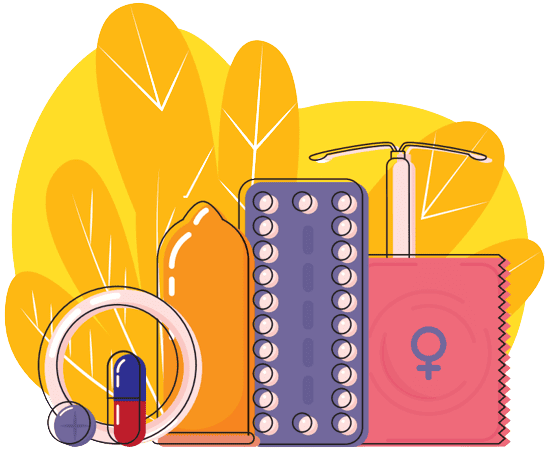
Family planning methods (birth control) or contraception can be short-acting or long-acting. These are available at GPs, polyclinics and hospitals. You should discuss your options with your doctor. Your doctor will further guide you to choose the safest and most effective contraception.
Short-Acting Contraceptives refer to contraception that require close monitoring and which need to be used before engaging in sexual intercourse, or taken daily. Such contraception includes:
- Natural rhythm – having sexual intercourse out of the ovulation period or “high risk of pregnancy” period
- Condoms
- Oral contraceptive pills
- Patch
Long-Acting Contraceptives refers to contraception that do not need monitoring on a daily basis. Fertility usually resumes once the contraception is ceased.
Options can be:
- Reversible
- Intrauterine Contraceptive Device (IUCD)
- Implanon
- Depo Provera
- Intended to be permanent and as a last resort
- Ligation/Sterilisation
- Inserted on Day 2 to 5 of menses, OR when reliably certain that the woman is not pregnant
- Lasts for 5 years
- Inserted on Day 2 to 5 of menstrual cycle, OR when reliably certain that the woman is not pregnant
- Lasts for 3 years
- Needs a small incision (cut in the skin) for removal, under local anaesthesia
- Can be inserted immediately after delivery
- Day 2 to 5 of menstrual cycle, OR when reliably certain that the woman is not pregnant
- Within the first 5 days post-delivery if not breastfeeding
- If exclusively breastfeeding, ONLY at the sixth week post-delivery
- Laparoscopic – key-hole surgery, usually done at least 6 weeks after delivery
- PPS – a small incision is made below the umbilicus, performed immediately post-delivery or at the same setting during a caesarean section
- Placement of clips on the Fallopian tubes or salpingectomy (surgical removal of Fallopian tubes)
- The doctor will ensure the patient is not pregnant before the procedure is performed
- Hormonal contraception needs to be continued for 7 days after the procedure till the next menses
I. IUCD
Mirena (hormone-related) or Copper (non hormone-related)
II. Implanon
III. Progesterone injections – Depo Provera (3 monthly injections)
First Injection on:
If the time interval between injections is greater than 13 weeks, the doctor will need to determine that the woman is not pregnant before administering the injection.
IV. Laparoscopic ligation/Post-partum sterilisation (PPS)
Done under general or regional anaesthesia (spinal/epidural)
Reference: KK Women’s and Children’s Hospital
Perancangan keluarga bertujuan untuk menjarakkan kelahiran anak yang telah disepakati oleh anda berdua. Ini tidak sama sekali bertujuan untuk tidak memiliki anak.
Perancangan ini penting untuk:
- Suami isteri yang belum bersedia untuk menimang anak terutama dari segi fizikal, mental dan kewangan
- Pengurusan kewangan – Ini akan memberi peluang untuk anda sekeluarga menikmati kehidupan yang selesa
- Ibu yang baru melahirkan supaya pulih dari segi fizikal dan emosi sebelum hamil semula
- Memberi peluang anak yang baru lahir untuk mandapatkan sepenuh perhatian dan susu badan yang secukupnya
Ini akan membantu pasangan untuk sama-sama memelihara kesihatan yang lebih baik untuk isteri, suami dan anak-anak. Jika anda berdua berbincang dan mendapati yang anda belum bersedia untuk membina keluarga sendiri, jumpalah doktor untuk mendapatkan nasihat.
Dengan cara ini, anda akan diberikan pil perancang atau cara menjarakkan kehamilan yang tepat dan sesuai.