Why is play important?
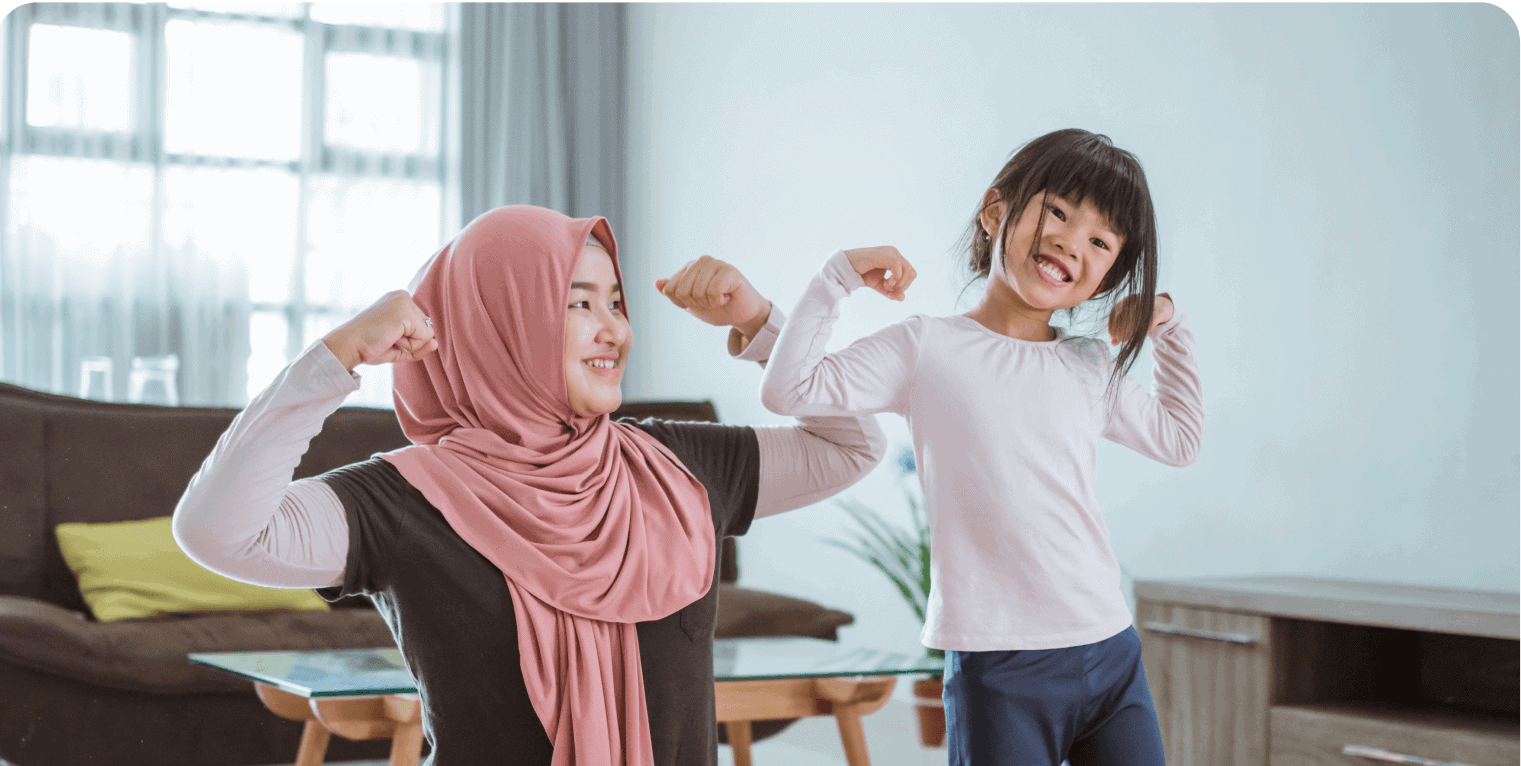
Play helps your child to achieve his full developmental potential in a fun and enjoyable manner. It allows your child to explore and interact with the world around him. Your child will learn how to manage his feelings in relation to others and understand the functions and properties of daily objects. It also provides an ideal opportunity for you to bond with your child.
Aside from strengthening the bond and developing their motor and cognitive skills, playing with children is an act of kindness and mercy that was exemplified by the Prophet s.a.w.
It was narrated from ‘Abdullah bin Shaddad r.a. that his father said: “The Messenger of Allah s.a.w. came out to us for one of the nighttime prayers, and he was carrying Hasan r.a. or Husain r.a. The Messenger of Allah s.a.w. came forward and put him down, then he said the Takbir and started to pray. He prostrated during his prayer and made the prostration lengthy.”
[Sunan an-Nasa’i: 1141]
My father said: “I raised my head and saw the child on the back of the Messenger of Allah s.a.w. while he was prostrating so I went back to my prostration. When the Messenger of Allah s.a.w. finished praying, the people said: “O Messenger of Allah, you prostrated during the prayer for so long that we thought that something had happened or that you were receiving a revelation.’ He said: ‘No such thing happened. But my son was riding on my back and I did not like to disturb him until he had had enough.”
Here, we can see that the Prophet showed mercy and kindness by being sensitive about the child’s feelings. He knew that it is in the child’s nature to play. He did not rebuke his son or shove him away although he was performing his prayer which requires deep concentration. Letting children explore their surroundings will have positive benefits in the long-term and it is in our tradition to aid our children in developing their potential.
- Tummy time
- Lay your baby down on his tummy on a playmat/mattress or in his cot
- Place some baby-friendly toys within reach
- Do this up to twice a day, 10-20 minutes each time
- Always make sure your baby is supervised at all times, he may start rolling soon!
- Cuddle your baby, use a changing tone of voice and varying facial expressions. Or sing to him!
- Tickle and blow on your baby’s tummy
- Stimulate your baby with toys that are colourful and make noise (e.g. using rattles)
- Note that loud music or TV shows can startle and cause distress to your baby. It is important to create a safe and calm atmosphere at home for your baby
- Provide your baby with toys of different shapes and textures (e.g. soft, hard, rough)
- You can even use common household items such as baby spoons, plastic cups or bottles, empty tissue boxes and tissue rolls
- Play peek-a-boo
- Bath time
- Place child-safe items (e.g. cups with handles, balls, sponges) in the baby bath-tub
- This is a great time for your baby to explore and learn, but remember to never leave your baby alone, even for a minute!
- Mirror play
- Smile, make faces and watch as your baby taps or pokes at his reflection
- Making eye contact with your baby is great for building bonds
- Use a bucket and large spoon to scoop up water or sand
- Scribble on paper using crayons, pencils or markers
- Play “Masak-masak”
- Pretend to cook and serve each other meals
- Go for a walk in the neighbourhood
- Listen to different sounds (e.g. birds, cars, footsteps)
- Find different surfaces to walk on, like grass, sand, concrete pavement and leaves
- Jump on each other’s shadows
- Ball play
- Throw, kick and catch a ball together
- Paint using interesting textures such as sponges and toothbrushes or try finger or foot-printing
- Mixing colours
- Help your child learn about mixing primary colours using food colouring and water
- Lie on a large sheet of paper and draw around your outlines, then fill in face and body details
- Construct a homemade telephone with two plastic cups and a string
- Press, roll and cut out shapes using playdough or home-made dough
- Go camping
- Make a tent using things you can find at home, e.g. bedsheets
- You can even make an obstacle course with chairs, pillows or boxes
- Make sure that the items used will not fall over or hurt your child
Play Ideas for your baby (3 to 6 Months)
Babies first learn to recognise your voice, face, and touch, and associate them with comfort. They then explore through grabbing and putting things in their mouths. Try out the following play ideas:
Play Ideas for your baby (6 to 12 Months)
As your baby becomes more mobile, he will love to explore his surroundings. Here are some play ideas to stimulate him:
Play Ideas for your toddler (12 to 24 months)
As toddlers start to move independently, they need to practice motor skills such as pushing, pulling and developing hand-eye coordination. As they start to talk, they need opportunities to practise speaking. Their attention span is short and they need a lot of changes in activity. Their world is also expanding and they like to go for small outings. Try these play ideas:
Play ideas for your pre-schooler (2 to 3 years)
Pre-schoolers are beginning to learn to share and take turns, and they like imaginative and pretend play. They also like activities which allow them to move about freely, such as running, climbing and riding pedal toys. Try out the following activities with your pre-schooler:
What you need to know about toys
Often, parents may feel that they need to buy lots of toys for their young children. However, having many toys may not allow children to use their own imagination and create their own games. This can lead to children playing with them for a while and then wanting more.
Rotate a few toys and resources that allow your child to be creative. These will be more valuable than a large number of expensive toys.
Examples of valuable ‘toys’ for your child are:
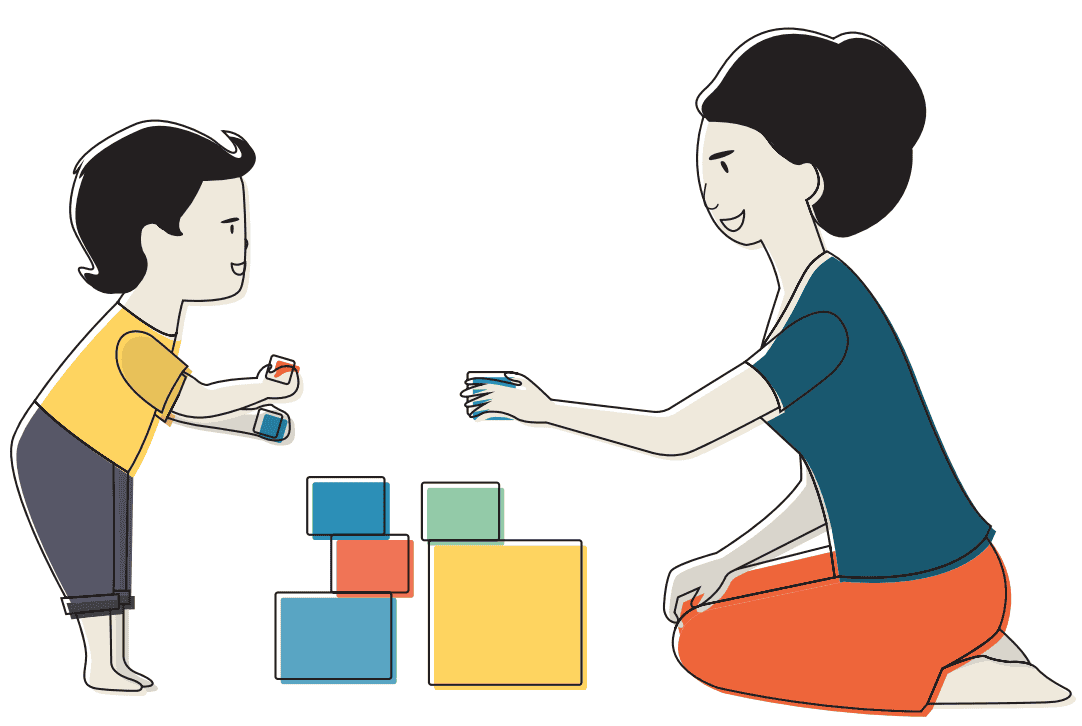
- Wooden blocks
- Pots, pans and cooking sets
- Boxes of all shapes and sizes
- Large sheets of paper and washable crayons or watercolour paints
- Old clothes for dressing up and pretend play
- Toys to ride on or pedal
Toy safety
- Check that the toy is of sound quality or has a Safety Mark (e.g. CE mark) or LION Mark.
- Make sure that the age range of the toy is suitable for your child’s age.
- Check for loose parts, small detachable parts or sharp edges.
- Any cords or strings should be less than 15cm to prevent accidental strangulation.
- Avoid giving your young child balloons, small balls, marbles or magnets.
- Check toys regularly for wear and tear. Discard if broken.
- Keep batteries locked away. Toys should ideally have a screwed-on battery compartment.
- Follow the instructions and warnings provided with the toy.
- Supervise your child during play at all times.
- Tidy up after playing to prevent tripping.
Things to note
- Play with your child but do not take over. Let your child determine the game.
- Talk about what your child is doing and encourage him (e.g. “It looks like Dolly is going shopping. What does she want to buy?”)
- Appreciate and encourage your child’s efforts (e.g. display his work on walls or the fridge).
Play is about focusing on the process, not the end product. Have fun teaching, learning from and bonding with your child!
Reference: KK Women’s and Children’s Hospital, Office of the Mufti (MUIS)
Pentingnya Bermain dengan Anak Anda
Meluangkan masa dengan anak anda dan bermain bersama mereka boleh menyemarakkan rasa kasih sayang dan mendekatkan diri anda dengan anak-anak anda. Ini juga membolehkan anak anda berinteraksi dan meneroka alam di sekitarnya dengan penuh keyakinan. Selain memperbaiki kemahiran dalam berkomunikasi dan mengawal perasaan, bermain dengan ibu bapa dan adik-beradik mengeratkan lagi ikatan kekeluargaan.
Bagi bayi kecil, luangkan masa untuk latihan meniarap (‘tummy time’) sekali atau dua kali sehari. Berada di posisi meniarap dapat melatih otot-otot leher dan tubuh bayi. Pastikan bayi anda dibaringkan di tempat yang selamat seperti tilam atau tikar bayi. Gunakan objek yang berwarna-warni untuk memberi bayi anda stimulasi.
Apabila anak anda semakin membesar, mungkin anda rasa terdesak untuk membeli pelbagai jenis mainan. Sebenarnya, memiliki banyak sangat mainan menghindari daya imaginasi dan kreativiti seorang kanak-kanak. Anda tidak perlu beli mainan yang banyak atau mahal untuk anak anda. Sebaliknya, mainan-mainan seperti blok pembina, alat mainan masakmasak, kotak-kotak beraneka saiz dan kertas bersama alat lukis lebih berkesan kerana dapat digunakan berkali-kali dengan pelbagai cara.
Jangan lupa juga luangkan masa untuk aktiviti fizikal seperti bermain di taman permainan atau di padang bola. Ini juga memberi anda peluang untuk beriadah bersama anak anda.